
Introduction
In the rapidly developed construction industry, building information modeling (BIM) has exceeded just a technological advancement – this is a fundamental requirement. When the MEP (mechanical, electrical and plumbing) systems are integrated into the system, BIM changes commercial construction by improving efficiency, coordination, accuracy and cost control. For companies like HTC Design Limited, BIM for MEP is at the core of giving high quality, conflict-free and durable design.
What Is BIM for MEP?
In the rapidly developed construction industry, building information modeling (BIM) has exceeded just a technological advancement – this is a fundamental requirement. When the MEP (mechanical, electrical and plumbing) systems are integrated into the system, BIM changes commercial construction by improving efficiency, coordination, accuracy and cost control. For companies like HTC Design Limited, BIM for MEP is at the core of giving high quality, conflict-free and durable design.
The Role of BIM in Commercial Construction
Commercial buildings – such as offices, hospitals, shopping malls and hotels – are complex structures with complex MEP systems. These systems must work basically to ensure comfort, safety and energy efficiency. MEP can lead to a small error or inspection in the design:
Project delay
Budget overran
Is expensive
And even security risk.
By using BIM, engineering consultants like HTC Design can visualize, coordinate, and optimize MEP layouts with extraordinary precision. Here’s how:
1. Improved Coordination and Clash Detection
One of the biggest challenges in commercial construction is to coordinate many subjects. HVAC ducts, plumbing pipes, and electrical conduights often compete for the same roof or wall space. In traditional design, such overlaps can only be discovered on the site-results in deer and redisine.
BIM enables the MEP system and architectural components to detect real -time clash between the system and structural components. In HTC design, our engineer uses devices such as autoodescribe and neviswork to quickly detect and solve the clash in the design phase. This active approach changes reduces orders and ensures smooth construction.
2. Enhanced Accuracy and Efficiency
Manual MEP pictures are prone to human error. Miscalculations, missing components, and incorrect layouts can compromise the entire project.
BIM brings high levels of accuracy and automation. Each duct, pipe and cable tray are designed with an exact dimension and real -world properties. Changes in a part of the model automatically update to all ideas, reducing the risk of discrepancies.
For HTC design, this means faster design cycles, low modifications, and better quality assurance for commercial customers.
3. Cost and Time Savings
Design errors are one of the biggest cost drivers in reunioning. By imagining and imitating the entire MEP system before the construction starts, Bim helps:
- Avoid wastage of material,
- Reduce labor disabilities,
- Adapt the installation sequences.
A well -coordinated BIM model reduces the number of RFIs (requests for information) during manufacturing, which saves significant costs and time.
Our team in HTC design often sees 30% time savings on commercial projects through the initial phase coordination and BIM-based scheme.
4. Energy Efficiency and Sustainability
Today’s commercial customers demand more energy-skilled buildings. BIM supports this goal by enabling energy analysis during the design phase. With bim, we can simulate:
- HVAC System Performance,
- Light load,
- Natural ventilation,
- Solar risk and cinematography.
This allows HTC design to recommend the optimal tool size and energy-saving layout, combining with a Leed or Green Building Certificate. In short, BIM helps in future proof commercial projects for both performance and stability.
5. Better Communication with Stakeholders
BIM models provide visual clarity that cannot do 2D pictures. Retendor-especially can understand the spatial layouts, the passage of services and system interactions from the stakeholder-especially non-technical ones. This transparency improves communication:
- Architect,
- Structural engineer,
- Contractor,
- Facilitation Manager.
The HTC design uses a coordinated BIM model during design design reviews and customer presentations, ensuring that everyone is on the same page and is reducing misunderstandings.
6. Lifecycle Facility Management
Commercial buildings require ongoing maintenance. BIM supports the facility management by embedding detailed information about MEP components – such as make, model, installation date and maintenance program. This allows building owners and convenience managers:
- Track system display,
- Planning of maintenance works,
- Plan to upgrade equipment,
- Expand the lifetime of assets.
The BIM models built in the form of HTC design distribute as a digital twin for long -term asset management, adding value beyond the project handover.
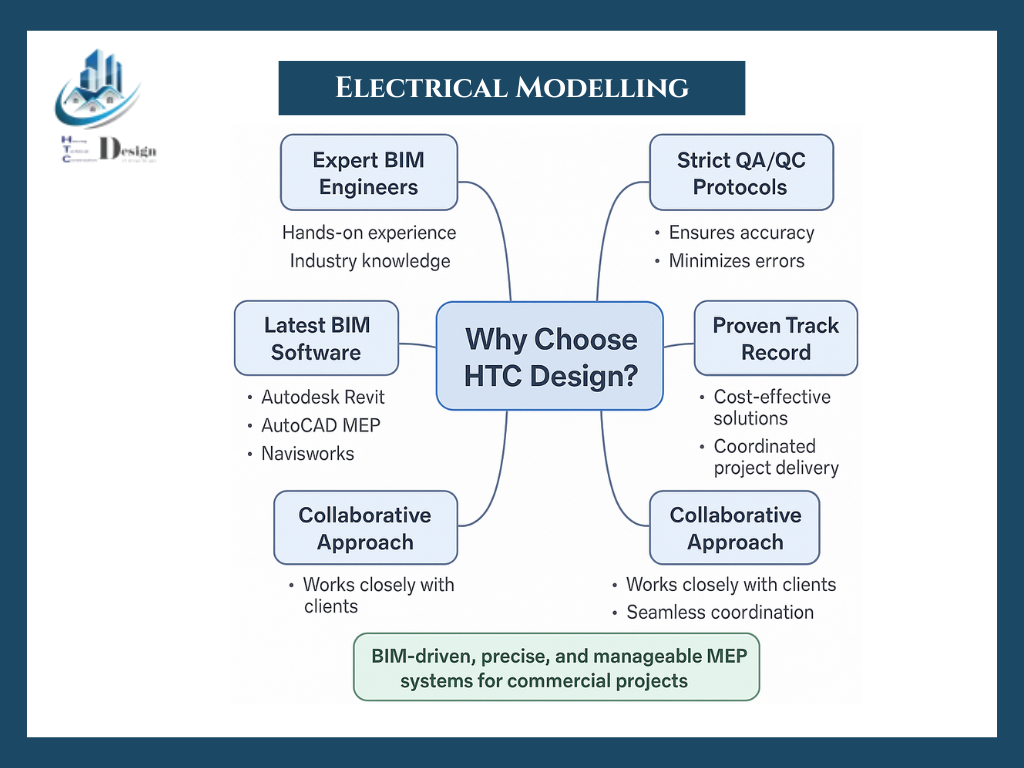
Why Choose HTC Design for BIM-Based MEP Services?
In HTC Design Limited, we specialize in Bim-Acified MEP design services for commercial projects. Does separate us here:
- Expert engineer with bim proficiency on hands
- Use of latest software: Revit, Autocad Meep, Navisworks, etc.
- Tightening QA/QC Protocol for Model accuracy
- Proven track record in coordinated, cost-affected MEP design
- Cooperative approach with customers, contractors and architects
We understand that each commercial project is unique, and our bim-powered functioning ensures that each MEP system is properly executed, efficiently executed, and easily managed.
Conclusion
As commercial buildings become more complex, the need for coordinated, energy-skilled and conflict-free MEP systems becomes significant. Bim is not just a design tool-it is a strategic property that strengthens better decisions, less surprise and long-term savings. Looking for reliable MEP solutions for developers, architects and project managers, BIM integration is no longer optional – this is necessary.
Partners with HTC design to experience the full potential of BIM for MEP in your next commercial construction project.